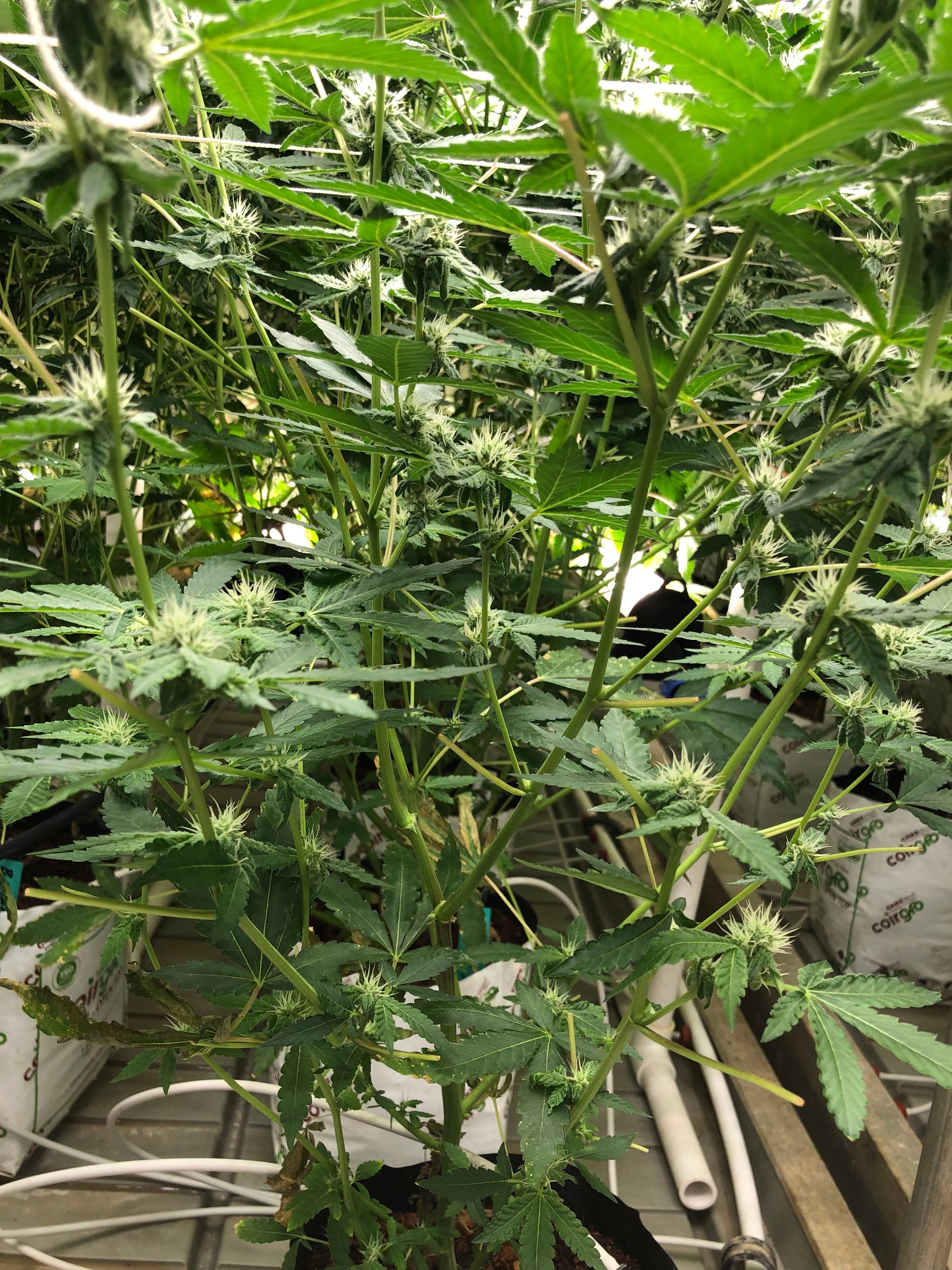

Lower canopy yield improvement depends on more than adding light below the plant. Better light can help activate shaded lower growth zones, but light alone does not automatically create stronger harvest results. In a commercial indoor cultivation room, under canopy lighting yield depends on how well light, nutrition, irrigation, airflow, root-zone balance, and growing structure work together.
This distinction matters because many growers look at the lower canopy only as a lighting problem. They see weak lower flowers, add more light, and expect immediate improvement. In reality, bottom-up supplemental light creates yield potential. However, the crop still needs the right support system to convert that added light into better flower size, density, color, surface area, and finish.
For a basic explanation of bottom-up lighting, start with the fundamentals of lower-canopy uplighting. This article explains lower canopy yield improvement, under canopy lighting yield, lower flower development, and the larger system behind usable harvest value.
System Balance for Lower Canopy Yield Improvement
Indoor cultivation is a controlled environment, but that does not mean every part of the plant experiences the same conditions. The top of the canopy may receive strong light and airflow, while the lower canopy may sit in a shaded, humid, and less active zone. Therefore, improving yield requires correcting that imbalance without creating new stress.
Why Lower Flower Development Falls Behind
As plants mature, upper leaves and top flowers intercept most of the overhead light. Lower sites receive less usable light, less air movement, and often less consistent environmental exchange. Over time, this creates a performance gap between the top and bottom of the plant.
That gap shows up in several ways:
- Lower flowers stay smaller or less dense
- Color and finish may be less consistent
- Trichome coverage may be weaker
- More material ends up in lower-grade categories
- Trim time increases because flower quality is less uniform
Why More Light Raises Plant Demand
When lower plant tissue receives more usable light, more of that tissue can become active. That can be beneficial, but it also means the plant may need stronger support from nutrition, water, airflow, and environmental control.
If the crop receives better light but the rest of the system does not keep up, the response may be limited. The grower may see brighter lower zones without seeing a major improvement in finished harvest quality. As a result, lower canopy yield improvement should be treated as a system response, not just a lighting response.
Light Creates Opportunity, Not Automatic Yield
Light is the trigger that allows more photosynthetic activity. However, nutrition, irrigation, root-zone health, and airflow determine how well the plant can use that opportunity. A lighting upgrade can expose weaknesses elsewhere in the room, especially when the lower canopy has been under-supported for most of the cycle.
Usable Yield and Harvest Quality Matter More Than Raw Weight
One of the most important ideas in lower-canopy production is the difference between total yield and usable yield. Total yield measures how much material comes off the crop. Usable yield measures how much of that material meets your desired quality standard.
Why Raw Biomass Can Be Misleading
A crop can produce more total biomass without producing more high-value product. If the added material is loose, pale, underdeveloped, or difficult to trim, it may not improve the economics of the room.
That is why yield conversations should include:
- Grade distribution
- Flower density
- Color expression
- Trichome coverage
- Trim efficiency
- Percentage of top, middle, and lower material that meets target quality
Quality-Driven Yield Supports Lower Flower Development
The goal is not to make every lower flower oversized. Oversized does not automatically mean better. In many cases, the better goal is appropriate flower size, improved density, more usable surface area, better color, and a frosty, well-finished appearance.
A stronger lower canopy should look more finished, not just larger. This is where lower-zone lighting, nutrition, and microclimate all matter together. In other words, lower canopy yield improvement depends on the quality of the finished product, not only the amount of plant material.
Surface Area, Color, and Frost Matter
For commercial value, flower quality is visual and structural. Surface area, color, resin expression, and finish all influence how desirable the final product appears. In many cases, a lower flower that finishes well can be more valuable than a larger flower that lacks density or quality.
Under Canopy Lighting Yield and Bottom-Up Supplemental Light
The lower canopy usually receives leftover light from the top. That is not always enough to maintain strong development through the full flowering cycle. Bottom-up supplemental light helps by reaching zones that overhead fixtures cannot serve efficiently.
Light Direction Improves Lower Flower Development
Increasing top-light intensity does not always solve lower-zone weakness because upper foliage still blocks photons. Direction matters. When light comes from below, it can reach the underside of leaves, lower branches, and flower sites that are shaded from above.
For a deeper explanation of this mechanism, see why bottom-up supplemental light works.
Lower Flower Development Needs Consistency, Not Harsh Intensity
Lower-zone lighting should not be treated like a second top-lighting system. The goal is not to blast the bottom of the plant. Instead, the goal is to provide consistent usable light that supports lower flower development without creating heat stress, dry spots, or uneven plant response.
A strong lower-zone strategy usually focuses on:
- Even light distribution
- Appropriate intensity
- Clean spacing between bars or zones
- Compatibility with irrigation and airflow
- Consistent performance through the finishing window
When these factors work together, lower flower development becomes more predictable. This makes lower canopy yield improvement easier to evaluate across multiple crop cycles.
Nutrition and Fertigation Support Lower Canopy Yield Improvement
When more lower growth becomes active, the plant has more demand. That demand has to be supported. If nutrition and fertigation do not match the increased activity, the crop may not fully convert added light into better flower development.
Fertigation Supports Under Canopy Lighting Yield
Fertigation affects how consistently the plant receives nutrients and water. In a high-performance indoor room, under canopy lighting yield depends on more than fixture placement. It also depends on whether the root zone can support active plant tissue throughout the cycle.
This is where the broader cultivation system becomes important. Grow Pros Solutions approaches indoor cultivation through a complete system that includes environmental control, fertigation, nutrients, and facility support: Grow Pros Solutions Eco System.
Nutrition Gaps Can Limit Lower Flower Development
If nutrition falls behind added light, lower sites may stay underdeveloped even though they are better illuminated. The grower may see more activity at first, but the final flower quality may not improve as expected.
Common signs that the system is not keeping up may include:
- Lower flowers brighten but do not gain density
- Color expression remains inconsistent
- Development varies heavily from plant to plant
- Some zones respond while others lag behind
Light Without Nutrition Can Underperform
A plant cannot build better flower structure from light alone. It needs mineral nutrition, water movement, oxygen around the root zone, and stable environmental conditions. Therefore, treat lower-zone lighting as one part of the production system, not the entire system.
Irrigation and Root-Zone Balance for Under Canopy Lighting Yield
When the lower canopy becomes more active, irrigation strategy may also need attention. More active plant tissue can change water demand, transpiration behavior, and substrate response. Because of that, irrigation consistency can influence whether under canopy lighting yield turns into real harvest value.
Root-Zone Stability Supports Lower Flower Development
A stable root zone helps the plant respond more predictably to added light. If substrate moisture swings too much, or if EC behavior becomes inconsistent, lower flowers may not develop evenly.
The root zone does not need to be overcomplicated in this article, but the principle is important: if the plant is asked to do more, the root system must be able to support it.
Uneven Irrigation Can Hide Lighting Benefits
If some plants receive consistent fertigation and others do not, lower-zone light results may look inconsistent. That can make a good lighting strategy appear weak when the real problem is uneven water or nutrient delivery.
Before judging the lighting system, confirm that irrigation delivery, runoff behavior, and root-zone consistency are not causing variation.
Airflow and Microclimate Affect Lower Flower Development
The lower canopy often has less air movement than the top of the plant. Dense foliage, bench structures, and tight plant spacing can create small humid pockets around lower flowers. These microclimates can limit how well the crop responds to added light.
Air Movement Supports Lower Flower Development
Air movement helps maintain more consistent temperature and humidity around flower sites. It also helps reduce stagnant zones after irrigation events. When lower-zone airflow is poor, the plant environment becomes less predictable.
A lower canopy with improved light but weak airflow may still produce uneven results. For that reason, light and air should be planned together.
Do Not Overcorrect With Harsh Air
The goal is not aggressive wind. Too much direct airflow can dry surfaces unevenly or stress plant tissue. Instead, the goal is gentle, controlled movement that supports consistency around lower flower sites.
Microclimate Is Often the Missing Link
Room-level readings can look acceptable while the lower canopy behaves differently. When evaluating lower-zone upgrades, pay attention to the environment around the actual flower sites, not only the sensor mounted in open room air.
Room Structure Changes Under Canopy Lighting Yield
Yield is also affected by how much productive canopy area the room can support. Benches, racks, aisle spacing, and room layout all influence how efficiently the crop uses available space. As density increases, lower-zone planning becomes more important.
Rolling Benches Increase Productive Surface Area
Rolling benches and rack systems can improve facility efficiency by increasing usable canopy area. More productive surface area can support stronger output, but it also increases the need for better lower-zone planning.
If plant density increases without better lighting, airflow, and irrigation layout, the lower canopy may become more shaded and harder to manage. For commercial bench and rack systems, see Grow Rolling Bench.
Higher Density Requires Better System Design
A denser room can produce more, but only if the environment supports the density. Lower-zone lighting becomes more important as plant spacing tightens and canopy closure increases.
That is why under canopy lighting yield is not just a fixture decision. It is a room design decision.
How to Evaluate Lower Canopy Yield Improvement
The best way to judge improvement is to compare harvest results over a full cycle. Do not rely only on visual brightness or assumptions. Instead, compare the actual quality and value of top, middle, and lower material.
Compare Top, Middle, and Lower Material
Separate the harvest mentally or physically by plant zone. Look at whether the lower material is closing the quality gap with the middle and top zones.
Track Grade Distribution and Lower Flower Development
A good lower-zone strategy should improve grade distribution. More material should move into higher-value categories, and less should fall into low-grade or waste categories. At the same time, lower flower development should become more uniform across the room.
Measure Under Canopy Lighting Yield Over a Full Cycle
Under canopy lighting yield should be measured across the full crop cycle, not judged from a single visual inspection. Track usable yield, grade distribution, labor time, and lower-zone flower quality before making a final decision.
A/B Testing Makes the Result Clearer
Before scaling across a full facility, use one bench, row, or room section as a test area. Keep genetics, top lighting, nutrition, irrigation, and environment as consistent as possible. Then compare the treated zone against a similar untreated zone.
Energy and ROI Context for Lower Canopy Yield Improvement
Every lighting upgrade adds cost, so the return must come from better output value. If lower-zone improvements increase usable yield, improve grade distribution, reduce trim waste, or stabilize production, the economic case becomes stronger.
Facilities evaluating lighting or efficiency upgrades may also want to review rebate opportunities: Grow Lights Rebate. In some projects, rebate planning can help offset the upfront cost of a lighting upgrade and improve payback timing.
At this stage, lower canopy yield improvement should be judged by finished product value, not only by how bright the lower canopy looks during the cycle. Likewise, under canopy lighting yield should connect back to real harvest value, not just fixture output.
Final Takeaway on Lower Canopy Yield Improvement
Lower canopy yield improvement is not about adding light blindly. It is about making more of the plant productive while maintaining quality. Bottom-up supplemental light can help activate shaded lower zones, but nutrition, fertigation, root-zone balance, airflow, microclimate, and growing structure determine whether that light becomes real harvest value.
The strongest strategy is balanced: improve lower-zone light, support the plant with proper nutrition and irrigation, maintain airflow, and design the room so the crop can use every productive surface area. When these pieces work together, lower canopy yield improvement becomes more than a lighting upgrade. It becomes part of a stronger, more consistent harvest system with clearer under canopy lighting yield.
```