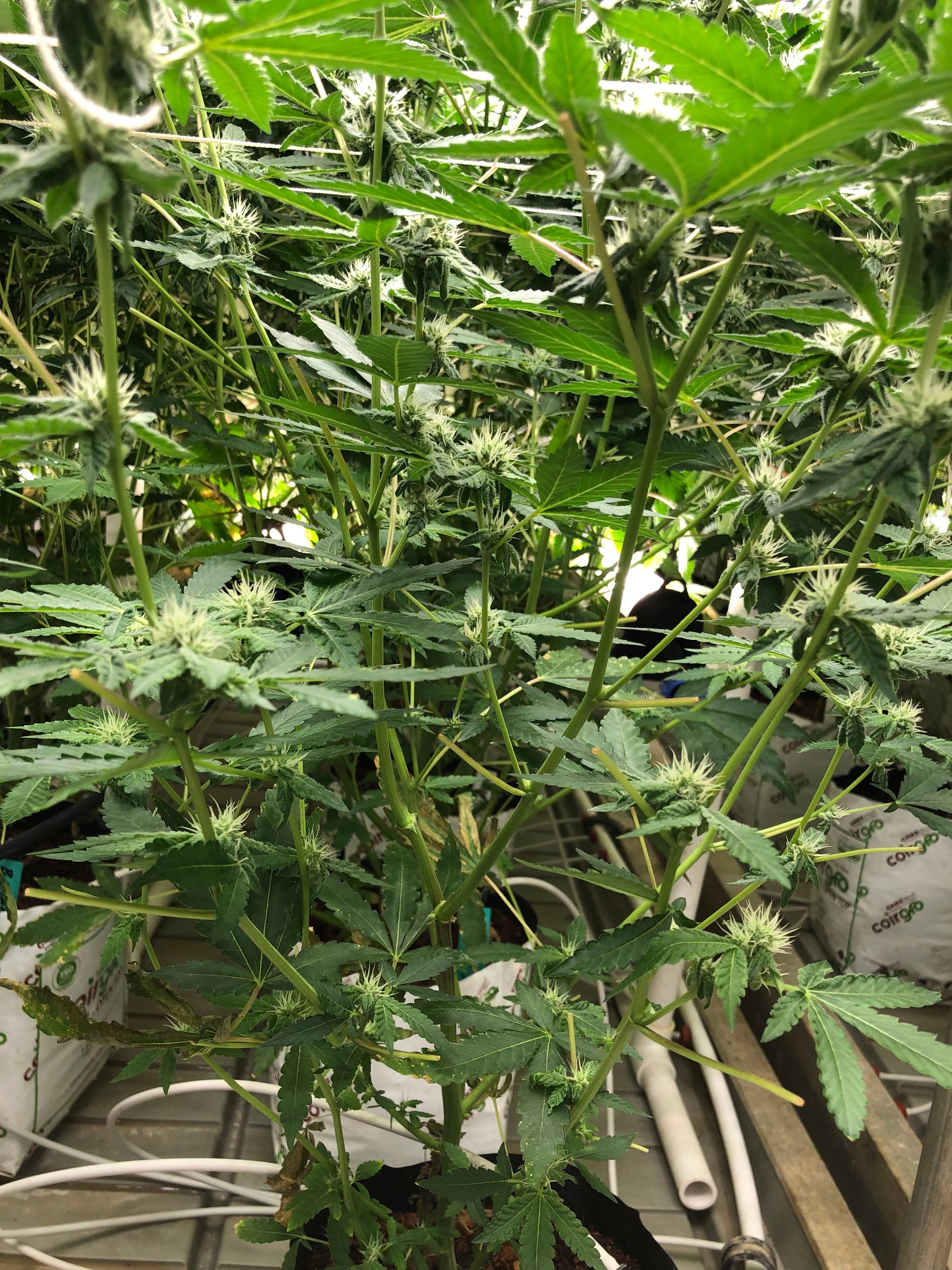

Under canopy grow lights are specialized LED fixtures designed to illuminate the lower portions of a plant that traditional top-mounted grow lights often fail to reach. In dense indoor environments, upper foliage blocks photons from penetrating deep into the canopy. As a result, lower bud sites often remain underdeveloped, less active, and less productive.
By installing LED bars beneath the canopy and directing light upward, growers can support shaded plant zones where photosynthesis often slows down. However, the purpose is not simply to add more light. Instead, under canopy lighting helps improve lower flower development, harvest uniformity, and usable production from the plant structure already inside the room.
For growers comparing fixture options, the full under canopy grow light collection is a good starting point.
Why Top Lighting Alone Is Not Enough
Modern LED grow lights are powerful, efficient, and capable of driving strong top-canopy performance. However, even advanced top-lighting systems cannot fully overcome canopy shading. As plants mature, overlapping leaves and flowers create dense layers that absorb, reflect, and scatter light before it reaches lower growth zones.
Consequently, growers often see several common production issues:
- Underdeveloped lower buds
- Reduced lower-zone photosynthetic activity
- Uneven flower size and density from top to bottom
- More low-grade material after harvest
- Wasted vertical space in high-density grow rooms
Therefore, under canopy grow lights solve a different problem than overhead fixtures. Instead of trying to force more light through the upper canopy, they send bottom-up light into the lower plant zone where top-down photons are weakest.
How Under Canopy Grow Lights Improve Yield and Uniformity
Under canopy grow lights can improve yield by helping lower bud sites stay more active through the flowering cycle. In addition, they can support more balanced development across the plant. Rather than allowing the plant to concentrate most of its production at the top, bottom-up lighting helps bring more lower sites into productive use.
Growers commonly use under canopy lighting to support:
- Better lower flower density
- More consistent flower sizing
- Improved usable yield percentage
- Reduced quality gap between top and lower material
- More predictable harvest grading
Moreover, these gains are especially meaningful in commercial rooms where output per square foot matters. The value is not only in total weight. Rather, the real value is often better usable yield, better grade distribution, and less material falling into lower-value categories.
For a deeper technical breakdown, read: how under canopy lighting affects yield in indoor cultivation.
Common Applications for Under Canopy Lighting
Under canopy grow lights are most effective in environments where shading is unavoidable. For example, they are commonly used in commercial indoor cultivation rooms, greenhouse systems, rolling benches, and multi-tier rack layouts where plant density is high.
Typical applications include:
- Commercial indoor flowering rooms
- Rolling bench and table systems
- Multi-tier grow racks
- High-density canopy layouts
- Facilities focused on usable yield and harvest consistency
Additionally, facilities using bench systems often integrate under canopy LEDs alongside structural components to maintain consistent spacing and coverage. In these layouts, under canopy lighting works best when fixture placement, plant spacing, irrigation access, and maintenance pathways are planned together from the start.
For commercial bench and rack systems, visit: Grow Rolling Bench.
Single Channel vs Dual Channel Under Canopy Grow Lights
Under canopy grow lights are typically available in single-channel and dual-channel configurations. In general, single-channel units deliver a fixed spectrum, such as full spectrum or red-dominant output. Meanwhile, dual-channel fixtures allow growers to control or adjust spectral output based on crop stage, room strategy, or cultivar response.
Dual-channel under canopy grow lights may include combinations such as:
- Red + Far-Red
- Red + UVA
- Full Spectrum + Supplemental Red
As a result, adjustable spectrum gives growers more control. However, it should be used with a clear purpose. Far-red, UVA, and red-heavy channels can affect plant behavior differently, so spectrum selection should match the room’s goals and crop management strategy.
For more detail on spectrum selection, read: under canopy lighting spectrum guide.
Installation Considerations and Placement
Proper placement is essential for effective under canopy lighting. Specifically, the fixture should be mounted beneath the plant canopy, with the LED face directed upward toward shaded lower branches and flower sites. The light should not point down into the tray, bench, or floor area.
Key placement considerations include:
- Mounting height relative to lower flower sites
- Consistent spacing across benches or rows
- Clearance around stems, media blocks, and irrigation lines
- Safe cable routing and service access
- Compatibility with airflow and cleaning routines
When installed correctly, under canopy LEDs integrate into the grow layout without disrupting daily operations. Therefore, the best layouts keep the light bar stable, accessible, and aimed upward into the plant zone where it can actually help.
For tray and irrigation layout planning, see: drip hydroponic tray layout tips.
This is especially important because under canopy grow lights perform best when the LED face is aimed upward into the lower plant structure rather than toward the tray or floor.
Why Lighting Must Work With Nutrition and Environment
Under canopy grow lights can increase lower-zone activity by giving shaded plant tissue more usable light. However, bottom-up LED lighting alone does not create a better harvest. When more plant tissue becomes active under supplemental under-canopy fixtures, the crop may also require stronger support from nutrition, irrigation, airflow, and environmental control.
If nutrients, moisture, or root-zone conditions do not keep up, the added light may not translate into better flower development. For this reason, under canopy lighting should be treated as part of a complete cultivation system rather than a standalone fix.
Grow Pros Solutions supports broader indoor cultivation planning through its Grow Pros Solutions Eco System, which includes system-level support for nutrients, fertigation, environmental control, and commercial facility planning.
Energy Efficiency and Rebate Opportunities
One of the advantages of under canopy grow lights is their efficiency. Compared with older lighting technologies, modern under canopy LED bars can deliver targeted output with lower heat and better photon efficiency. Consequently, these supplemental fixtures are practical for dense flowering environments where lower plant zones need additional light without raising top-canopy intensity.
In many regions, efficient grow lighting upgrades may also qualify for utility rebate programs. Therefore, these incentives can help reduce upfront project costs and improve the return on investment for commercial facilities.
For rebate guidance and incentive planning, visit: Grow Lights Rebate.
Choosing the Right Under Canopy Grow Light
Selecting the right under canopy grow light depends on your room layout, crop goals, spectrum strategy, and installation structure. In particular, the right under canopy lighting fixture should match the physical space, provide the correct upward light direction, and integrate cleanly with benches, racks, trays, and irrigation hardware.
Factors to evaluate include:
- Fixture length and coverage area
- Single-channel or dual-channel spectrum
- Mounting method and housing durability
- Electrical integration and controller compatibility
- Heat output and service access
For example, if you want to see a practical reference product, review this full-spectrum option: 4ft Full Spectrum Under Canopy Grow Light.
This type of fixture is commonly deployed beneath benches and around plant-base zones to support shaded lower growth without increasing top-light intensity. In this way, it can complement the main lighting system rather than replace it.
Final Thoughts on Under Canopy Grow Lights
Under canopy grow lights are no longer an experimental add-on. Instead, they are becoming an important part of modern indoor cultivation strategies because they address a real limitation of top-only lighting: shaded lower plant zones.
Ultimately, the best results come from using under canopy lighting as part of a complete system. Fixture direction, spectrum, spacing, nutrition, irrigation, airflow, and bench layout all matter. When these pieces work together, under canopy grow lights can help improve flower uniformity, usable yield, and overall production consistency.